 Allegra Verlezza – Queer, Genderfluid & Non-Binary Voiceover
 Allegra Verlezza – Queer, Genderfluid & Non-Binary Voiceover
Link to full profile: bluewavevoiceover.com/voices/allegra-verlezza
Email: allegra@allegraverlezza.com
If you’re looking for a queer, non-binary and genderfluid voiceover talent who can deliver your political spot with authenticity and passion, meet Allegra Verlezza! Allegra (they/she) is a proud member of the LGBTQIA+ community and as a genderfluid person, feels comfortable and affirmed voicing roles for women and non-binary folks. They are committed to amplifying progressive messages that advance real, meaningful change.
Tell us a little about your broadcast-quality home studio. Where is it? What kind of equipment do you have? What do you like about it?
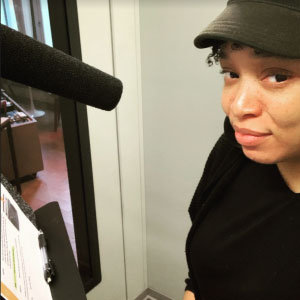
My home studio is a creative hybrid of a closet booth and a free-standing blanket booth in my Brooklyn apartment. My closet and its doors are completely lined with 2 inch thick foam panels and I situate myself and my mic between the open closet doors. I have Producer’s Choice sound-absorbing blankets running along a ceiling track outside of the closet that act as curtains and quietly enclose my booth. As for light, I have a dreamy curtain of twinkle lights behind me which makes it feel like the coolest blanket fort ever.
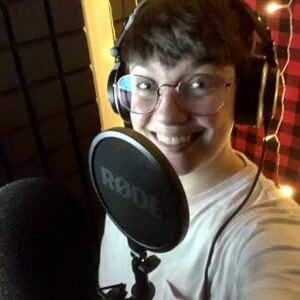 In terms of equipment, I have a Rode NT1 mic, Solid State Logic SSL2 audio interface, and a computer monitor hooked up to my Macbook Air that sits right outside of my booth. I found these nifty mobile, adjustable desks that are meant for close-quarters living in a college dorm (not unlike living in NYC) and I converted two of them into mobile booth desks. All of my tech, including my iPad for reading scripts, either sits on these desks or are clamped to the sides so none of my equipment has to be fixed to one spot. Most of the time I stand so I can access my full range of wacky and dramatic movement but if I have a longer session, I can easily pop a stool into the booth since all my equipment is mobile.
I love this accessible and malleable quality about my booth because it means I always have the room to move and be physically present as an actor. What I don’t like about it? Well, it’s situated next to a window that looks out over a loooong row of backyards so I could do without the trees knocking against my building, music blasting, or the flocks of birds that seem to run formation drills every afternoon.
Update: my cat has discovered that he can claw open my blanket curtains and zoom around me. Send help.
What’s one thing that most people don’t know about you?
My first foray into performance was through dance! I grew up in a family of modern dancers, who specialized in making dance accessible to people of abilities and minds. I spent many years studying modern dance and ballet and I still love to dance – especially at queer dance parties! This early exposure to diverse types of movement and just being comfortable with wiggling my limbs really instilled in me a deep presence and comfort with moving my body. I totally bring this connection to dance and my body into my booth because as we know, EVERYTHING influences the voice and vocal performance and that definitely includes moving and feeling alive and activated in my body.
How did you get into voiceover work?
Buckle in. From being a cartoon-obsessed kid to a high school theater dork to an adult actor who convinces all their friends to watch the latest animated shows – especially the growing number of cartoons with LGBTQ+ rep – I LOVE vocal performance! I always have. It’s just…its own kind of magic when an actor breathes life into a bunch of moving lines and color. I wasn’t always able to name and celebrate this passion though. The person who gave me the confidence to own my continued love of cartoons as an adult is Rebecca Sugar, cartoonist/artist/showrunner extraordinaire and creator of Steven Universe. And a fellow bisexual and non-binary creative! Watching the literal slew of diverse LGBTQ+ characters in her show, I saw myself for the first time in a cartoon. Listening to interviews where Sugar speaks so unapologetically about her lifelong love of animation was a really healing experience for me as a young person who (is this not ridiculous?) was put down a lot for loving these animated shows that quite literally saved my life. I even got into cosplay!
 SO. This beautiful moment of self-actualization along with still loving acting and being miserable at my first job out of college made me think, “well, why can’t I try voice acting and being in cartoons?” I started researching classes and then the real catalyst was a colleague of mine who saw me LIGHT UP with curiosity and joy when she mentioned that her sister worked full-time in animation. That colleague connected me to her sister who connected me to someone else in the industry (are you following?), who generously took the time to have coffee with me and answer alllll my questions about getting into voice acting and children’s media. I walked out of that midtown coffee shop, whipped out my phone, and signed up for my first voiceover class.
And you know what I found? There are SO MANY awesome types of voiceover! I hopped from class to class, discovering different genres – like political! – and jumped head-first into the incredible world of voiceover. The short answer – I took a class. The longish answer – a bunch of people paid it forward by being their full authentic selves and generously fostering other people’s joy.
What is your biggest voiceover pet peeve?
My biggest pet peeve in voiceover is when listeners assume a voice of a certain identity sounds a certain way. As a queer genderfluid person, this becomes personal when it comes to voice actors under the non-binary umbrella. The voiceover industry has made a lot of progress in terms of diverse casting but unfortunately, there are still a lot of expectations that a “non-binary voice” is a monolith and should “sound androgynous” or “neutral” or… non-gendered? My voice is full of gender! A big, colorful, messy painting of gender. And I “sound non-binary” because I am non-binary. Even though my voice isn’t mid-low range or what people often deem “androgynous-sounding,” I sound genderfluid because I am genderfluid. And there are non-binary voices that do have those qualities and that’s fantastic! It just shouldn’t be an assumed standard that is frankly grounded in patriarchal, cis-centric views of gender.
This automatic coupling of certain vocal qualities with certain gender identities (i.e. women’s voices sound like X and men’s voices sound like Y) fails to realize a beautiful truth: just as sexuality and gender identity are diverse spectrums, so is voice. And just like we’re unlearning so many things ingrained in us from the oppressive structures in our society, we’re unlearning assumptions and taught biases about what a certain identity’s voice sounds like. I encourage folks, in all fields but especially in voiceover, to not limit ourselves with rigid ideas about what a certain gender identity sounds like. What any identity sounds like, including women and men! Let’s embrace the fact that anyone can quite literally sound like anything. After all, my biggest voiceover LOVE is that this community is so supportive and this craft is all about being fully and authentically YOU.
What advice do you have for talents who want to do political voiceover?
Well, to follow up on the above, BE YOU. Be fully, freely, totally you. This advice goes for all genres of voiceover but especially when it comes to political work. (My gender studies degree is screaming everything is political! But let’s talk genre.) Go inward. Who are you and what are your fights? Go outward towards community. Who are you in solidarity with and who are you fighting for? Bring all of this specificity to your reads, even if it’s not you explicitly giving literal words to this. Bring the feeling, the passion, the urgency, the compassion, the humanity.
What hobbies do you have outside of your voiceover work?
Fiber arts! I’ve loved knitting ever since I begged my mom at the age of 8 to buy me a pair of needles and the COOLEST rainbow tie-dye yarn I found at Michaels (#CanonicallyQueer). I knitted throughout childhood – my mom still uses this lumpy eyeglasses holder I made for her, bless her heart – and after a several-year pause, I picked up a pair of needles again when I was feeling quite low in my early twenties. And my goodness does knitting do wonders for anxiety and depression! I love to be able to create something out of nothing with my hands. It occupies my busy mind and is a perfect way to relax my voice after a long day of auditions.

 Rosi Amador – Hispanic Female Voiceovers in English and Spanish
 If you could tell political voiceover clients one thing that would help you do your job better, or help them get what they want faster – what would that one thing be?
 Tell us a little about your broadcast-quality home studio. Where is it? What kind of equipment do you have? What do you like about it?
 Tell us a little about your broadcast-quality home studio. Where is it? What kind of equipment do you have? What do you like about it?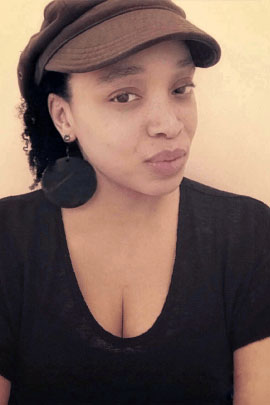
 Tell us a little about your broadcast-quality home studio. Where is it? What kind of equipment do you have? What do you like about it?