Blue Wave Voiceover blue wave logo
  • Home
  • Search Voices
    • Search Voices
      • Female Voice Talents
      • Male Voice Talents
      • Non-Binary & Trans Voice Talents
      • Black Voice Talents
      • Spanish Speaking Voice Talents
      • Asian American Voice Talents
      • Indigenous & Native Voice Talents
      • LGBTQIA+ Voice Talents
    • Voiceover for Commercials
    • Voiceover for Promos
    • Voiceover for Explainer Videos
    • Voiceover for e-Learning
    • Animation & Character Voiceover
    • Voice of God Voiceover Talents
    • Voiceover for Corporate Narration
    • Voiceover for Documentary Narration
    • Voiceover for In Show Narration
    • Voiceover for True Crime
    • Voiceover for Medical Narration
    • Voiceover for Telephone and IVR
    • Voiceover for Automotive
    • Voiceover For Radio Imaging
    • Voiceover for Video Games
    • Voiceover for Audio Drama
    • Voiceover for Audiobook Narration
    • Voiceover for Singing & Jingles
    • Funny Political Voice Over
  • Rates
  • FAQ
  • Resources
    • Intro to Voiceover Casting
    • How Do I Hire a Voiceover Artist?
    • Voiceovers for Democrats and Progressives
      • Celebrity Soundalikes
      • Political Voiceover Recording From Home Studios
      • Diverse Political Voiceovers
        • Diverse Gender Voiceover
        • Spanish Voiceover For Politicals
        • Female Black Voiceover
        • Hispanic Bilingual Female Voiceovers
      • Hire A Voiceover Artist Today
      • Political Voiceover Actors
    • Media Landscapes
      • Social Media
        • Facebook
        • YouTube and Hulu
        • Google
        • Instagram
        • Snapchat
        • TikTok
        • Other Options To Place Ads
      • Voiceover For COVID-19 Content
  • About
  • News
  • Contact
    • Request A Quote
    • Information For Voice Actors

Meet The Talent

Native and Indigenous Voice Actors

March 8, 2024 by Blue Wave Voiceover

If you’ve thought about hiring Native and Indigenous Voice Actors…

Now is the time to see what they can offer! In the past few years, Native representation has expanded in American pop culture. From Martin Scorcese’s film Killers of the Flower Moon, which brought a dark part of American history to cinemas, it also introduced Lily Gladstone who is now the first Native woman to be nominated as Best Lead Actress for an Academy Award. Recently the final season of the groundbreaking TV show Reservation Dogs wrapped up its story of Indigenous kids living on an Oklahoma reservation. And in the latest season of HBO’s True Detective, actress Kali Reis, whose heritage includes Wampanoag Native ancestry, plays a detective in an Alaskan Native community.
Although better representation of Native culture and history may be new for some, their participation in US politics has been vital even when it’s been historically denied. Championing diverse talent such as Native and Indigenous voice over actors at Blue Wave Voiceover is part of our collective’s mission to reflect how America looks today.

Amplifying their voices in politics and storytelling is critical as the 2024 presidential election begins. Hiring indigenous voice actors can really give your campaign credibility and authenticity this election season.

Diversity That Goes Beyond Stereotypes

Unlike old Hollywood stereotypes, Native culture and people are not a monolith. In the US, there are 574 federally recognized Indian Nations and 115 spoken indigenous languages. Although 99% are in danger of extinction, Navajo is the largest spoken language with 170,000 speakers. Casting across such a wide array of people can be daunting and writing specs for your spot is important to find the right talent that suits your needs. If it’s your first time hiring talent for a political campaign, we’re here to help.

What is the appropriate terminology for such a diverse group when nearly 10 million people identify as American Indian or Alaskan Native?

Addressing a Diverse People with Correct Terminology Today

Blue Wave Voiceover Carolina Hoyos Business
Carolina Hoyos

Native people prefer to be called by their specific tribal name according to the National Museum of the American Indian. The term “Native American” is still used but not widely accepted by groups instead opting for Native Indian, Indigenous American, or Indian. “Native” is used officially and unofficially to describe people from the United States (including Alaskan Natives and Native Hawaiians) and as a descriptor (Native lands, Native traditions, etc). If you’re ever unsure how to address a person, notice how they address themselves or ask their preference.

Contemporary Representation on Social Media

One way Native people have fought for social justice or amplified their community’s stories is through Tiktok . These infuencers are part of a wave of content creators who are sharing information on a powerful platform that has grown beyond just bite-size dance videos. Depending on which study you read, 10% or 74% of Gen Z users prefer using Tiktok as a search engine. #NativeTikTok alone has received more than 3.4 billion views (and that’s in 2021!). Harnessing the power of these digital platforms, Native people have found ways to spread their history and message to large followings. In an intense election year, understanding how some generations and communities are finding information online is critical for a blue wave.

The System Isn’t Made for Us
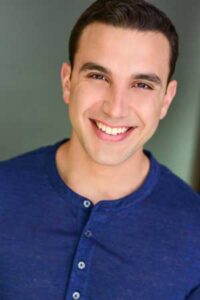
Blue Wave Voiceover Javier-Prusky
Javier-Prusky

Some of the challenges that Native and Indigenous voters face today is not wanting to participate in a system that wasn’t built to ensure their political participation as voters. For many they believe that the system was built to destroy their communities.

Before Native people were formally granted citizenship in 1924 by the US government, they often had to relinquish their rights to their own land or prove “civilized” assimilation in order to gain citizenship. But after decades of voter intimidation tactics, similar to what African Americans experienced, it wasn’t until the 1960s when the Voting Rights Act for Native Americans granted them the right to vote in every state.

Fast forward to 2020, six Native American and Native Hawaiians were elected to the House of Representatives – a record breaking number! One of those representatives, Deb Halaand, was appointed by the Biden administration to be the Cabinet Secretary of the Interior Department in 2021. As a member of New Mexico’s Laguna Pueblo, her position meant that she was in charge of the Interior Department – a branch of government that was historically instrumental in stripping away land rights from tribal nations. This hugely symbolic and historic appointment made national news.

Native People’s Voting Power in the 2024 Election

This year in Arizona, Young and Native People are an enormous influence on whether or not President Biden wins this battleground state. Democrats have noticed and mobilized on national and local levels in swing states. Yet more can be done. There are close to 5 million Native voters according to the US Census Bureau and they lean democratic. As Young Native voters decide how to wield their electoral power they say that politicians on both sides haven’t taken the time to get to know their communities. Issues like jobs, inflation, abortion rights, water access, and poor infrastructure are top of mind but voting challenges remain like driving hundreds of miles to the nearest polling station…if you have access to transportation.

Where handshakes and relationships are so important, politicians seem to not make the investment out of fear of not knowing how to approach tribal communities. The result is Native people being the biggest group who receives the least outreach from political parties. But these voters are a powerful electorate in tipping ballots when voter turnout is so critical.

Hire Professional Native and Indigenous Voice Talent
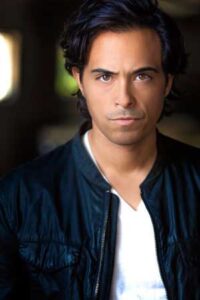
Blue Wave Voiceover Jason_Grasl
Jason Grasl

Casting Native voiceover talent is a great way to elevate your message for your campaign. Every one of our Native talent is unique and reflects the diversity of indigenous nations. Jason Grasl, another Blue Wave Voiceover member, is an indigenous Native American talent who has voiced spots for Comcast, Toyota, and McDonald’s.

If you’re looking to hire a voiceover actor who can speak an indigenous language, Carolina Hoyos may be able to lend her Quechua skills to your campaign. For her it’s important that Native voice actors be heard in political spots, “Native rights are human rights. States that surround and inhabit Native land should represent all those affected by laws and who we elect to represent us weighs heavily in the political landscape.”

Additionally, Javier Prusky has indigenous roots from the Charrúa Tribe in Uruguay. He recommends that it’s best to be specific and not generalize when casting for different cultures. “I am Latino, Indigenous, American, so my range and possibilities of playing shouldn’t be limited to one culture. I am a human being with many different sides and complex upbringing and customs, so it is important for the industry to not just see me (and us) as the ‘Native’ or ‘Latin’ one.”

If you’re Native or Indigenous and looking to get into voice over, here are some tips from our actors:

Carolina Hoyos: I’m a fan of training and development programs that can help to give us a boost in skills so we are going in with a competitive edge. Learn about the many different kinds of voice over work there is and find out what you like, get practicing, put together demos and once you’re ready, start your outreach.

Filed Under: Advertising, Representation, Democratic Platform Issues, Meet The Talent

AI vs. Human Voiceover

April 19, 2023 by Blue Wave Voiceover

The use of AI isn’t new for any of us. Artificial Intelligence, or “AI” is used in voice recognition systems like Siri and Alexa and powers recommendation engines for Netflix, YouTube, and TikTok to suggest content we might like. Latest news about ChatGPT showcases how AI technology is being used to generate everything from to-do lists, travel itineraries, code and emails to messages on dating apps. On the other side, there’s AI Suit Up: an AI-powered photography that promise high quality professional headshots without needing to physically step foot in a photography studio. Therefore, it’s no surprise that AI has been used to generate text to speech voiceovers with the promise of human-like emotion. Let’s chat about AI vs. Human Voiceover. 

AI voiceover generators promise quick, scalable options that can deliver the nuances of a human voice. But, many of these AI voiceover engines may not capture the depth and emotion to meaningfully connect with audiences. And with the barrage of messages folks receive today, the general public is getting VERY good at recognizing when a voice is not authentic. Just think about how you behave when you scream “REPRESENTATIVE” at your financial institution’s helpful phone system!

AI Voiceover Generators vs. Authentic Human Voiceover Actors

Working with a professional voiceover actor means working with someone who is dedicated to their craft and will work with you to deliver just the right tone and emotion to convey your message. This allows your message to resonate with audiences you’re looking to reach. You won’t need to listen for the emotion or wonder if the file sounds “human enough” especially when speaking about sensitive topics or messages that require a high level of care and nuance. The talent at Blue Wave Voiceover genuinely wants to get the right take and right delivery to help support your cause. We do this work because we want to voice content to elevate campaigns, organizations, and candidates that we actually care about!

You’ll have someone you can provide direction and feedback to so that you achieve exactly what you need in your audio–something that AI can’t offer due to its unpredictability and inconsistency.

Why Should You Use Professional Voiceover Actors Over AI Voiceover Generators? 

When working with AI voice over software, it’s hard to answer the question of who you’re working with, but you’ll know exactly who you’re working with when you hire one of the talents who are a part of Blue Wave Voiceover. If you’re looking for a particular voice to reach a particular audience, you’re sure to find that voice represented at among our roster. Our collective of voiceover actors mirror the diversity of America today so that the audiences you’re trying to reach hear themselves authentically reflected in your message.

Blue Wave Voiceover offers a variety of genuine authentic voices that are real and reflect diversity in ethnicity, gender, and age. We know that the modern media buyer would need diversity in ages (Millennials, Gen X-ers, Baby Boomers/Seniors), multicultural voices (including Asian-American and Pacific Islander, African American, and Hispanic bilingual voices), and gender (including male, female, transgender and gender nonconforming).

Cheap Software Can Ruin A Spot

If you’re spending a chunk of change on your media buy, as well as the firm you hired to execute your digital strategy – don’t opt for cheap artificial voice software instead of an authentic human performer, just to save a few bucks. Our voiceover actors offer fair and flexible budgets – we understand that a spot that is only running in Montana won’t command the same rate as a spot running in the New York tri-state region. We work hard to make sure all of our clients and customers across the world can afford to utilize authentic, diverse, professional voiceover artists for their creative. You might think you’re saving a quick buck by utilizing an AI voice generating engine. AI is great at a lot of things when it comes to saving time or aggregating data – but it can’t truly bring the emotion of America to life with all of the inflection, nuance, and importance that your content deserves.

So, why waste the money on a software engine you probably can’t take to air? Chances are? You’ll listen to the final product and realize there IS value in human creativity and you’ll want to hire a professional actor to bring your copy to life in a way a piece of software never can.

Work With A Trained Professional Voiceover Performer

When you work with a dedicated and trained voiceover actor, such as the professionals from Blue Wave Voiceover, you’re working with someone–an actual person–who is dedicated to serving and supporting your cause and mission. The full-time political voiceover actors on our roster are committed to supporting mission-driven groups, non-profit organizations, and Democratic and progressive candidates for office because they believe in ushering a Blue Wave each election season.

Filed Under: Media Production, Representation, Blog, Meet The Talent

Queer, AAPI & Genderfluid Voiceover – Meet Cherie B. Tay

May 11, 2021 by Blue Wave Voiceover

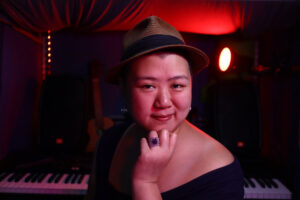
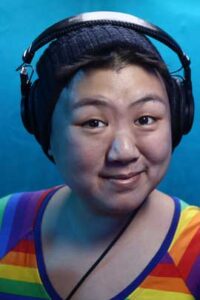
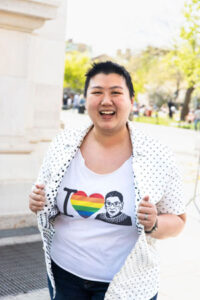
Blue Wave Voiceover A headshot of Cherie Tay, an AAPI voiceover artistLink to full profile: bluewavevoiceover.com/voices/cherie-b-tay
Email: cheriebtayvo@gmail.com

Cherie B. Tay – Queer, AAPI & Gender Non-Conforming Voiceovers

When you’re looking for an Asian American & Pacific Islander (AAPI) and LGBTQ+ voiceover talent who can deliver your voiceovers with a warm and velvet smooth energy, look no further than queer, gender non-conforming voice actor Cherie B. Tay! Cherie (she/they) brings a powerfully puissant energy to every read and is proud to lend their youthful, compassionate sound to progressive causes.

Tell us a little about your broadcast-quality home studio. Where is it? What kind of equipment do you have? What do you like about it?

I built a custom recording studio/booth in my living room in Brooklyn.

I have a Synco D2 shotgun mic on a boom arm, a Scarlett 2i2 interface, and a Macbook Pro that I have to put an ice pack under for live sessions.

I love that I can record music and VO in 1 booth. I also have professional monitors above my keyboard so I have options about listening to playback.

I have an entire blog post about it!
https://www.cheriebtayvo.com/blog/cheriebooth2020

What’s one thing that most people don’t know about you?

I used to be VERY quiet and shy. It took me a long time to find my voice and trust it. I also get intensely focused on things and want to be great at it immediately. Current obsession is Beat Saber on the Oculus.

How did you get into voiceover work?

I’ve wanted to do VO since 2010. I started chatting with people in Philadelphia about the industry and picked their brains about it. But theatre took over. I went on the road with a show, then kept working. Finally in 2019, I was working on a long running Broadway show, and André De Shields and Amber Gray kept telling me that I needed to get into VO work, and I listened. I had a LOT of help/advice starting from other VO cast members at my show.

Do you remember what your first voiceover job was?

I’ve done unpaid live announce and corporate VO work just from working as a stage manager on those events. My first paid job was playing a robot scientist on an audio drama podcast!

Do you remember the first political voiceover job that you did?

I’ve done a lot of theatre funding related political VOs since Broadway has shutdown.

What has been your favorite voiceover project to date?

I played a non-binary platypus in an animation!

I want to give back to what my younger self did not have/see represented. It’s so important to me to pave the way for the younger generation and show them that it will be okay to love and be themselves.

Why do you think voiceover will be an important part of political advertising in upcoming elections?

I think VO will always be important to political advertising. We have to represent those who do not have voices and make the world a better place. Helping candidates who I believe in is very important to me.

What issues would you like to see at the center of the Democratic platform for upcoming elections?

Healthcare, Equal rights & protection for women and LGBTQ+ people, Global Warming, Economic and Social Justice.

What is your biggest voiceover pet peeve?

People thinking that it’s “easy” and that they “just have to have a good voice”. It takes a lot of work and investment in equipment, classes, coaching, learning, and time.

If you could tell political clients one thing that would help you do your job better, or help them get what they want faster – what would that one thing be?

Give the full script once it’s done, get all the pickups from everyone who has input, then give the full pickup list back if needed (instead of one change at a time).

What advice do you have for aspiring voiceover talents that want to work in the political arena?

Keep learning! Keep going!

What hobbies do you have outside of your voiceover work?

Photography, Music (ukulele), Technology, Videography, Theatre, Cooking.

Is there anything else you’d like to add?

I have a full press page with a press kit! https://www.cheriebtayvo.com/press

If you’d like to book Cherie B. Tay on your next political voiceover project, please visit their profile here and get in touch!

Filed Under: Advertising, Representation, Meet The Talent

Diverse Gender Voiceover

May 6, 2021 by Blue Wave Voiceover

Supporting Transgender & Gender Non-Conforming Diverse Gender Voiceover Artists

Mauree-TurnerAs a collective of voiceover artists who look and sound like America today, Blue Wave Voiceover includes talents who identify across the diverse spectrum of gender. Blue Wavers are deeply passionate about voice actors of all gender identities having equitable access to inclusive and affirming casting opportunities. We’re excited to see that the wider voiceover world is evolving towards more inclusive casting, particularly for actors who face daily discrimination, like transgender and gender non-conforming (TGNC) voice talents.
And we’re seeing an important shift in the world as well. More and more TGNC people are running for office like Brooklyn Owen, who is running for State Senate in Florida to pay it forward to the Jacksonville community who took her in when her family kicked her out as a teenager for being who she was. Many TGNC candidates are winning their races like Delaware Democrat Sarah McBride, the first transgender person elected to a state Senate and Oklahoma Democrat Mauree Turner (featured right), the first non-binary person elected to a state legislature. In mainstream media, trans visibility is at an all-time high with celebrities like Laverne Cox and Elliot Page taking to the covers of TIME magazine to tell their stories and Janet Mock directing the groundbreaking show “Pose” that spotlights NYC’s African-American, Latin and Hispanic LGBTQ+ ball culture in the ‘80s and ‘90s.

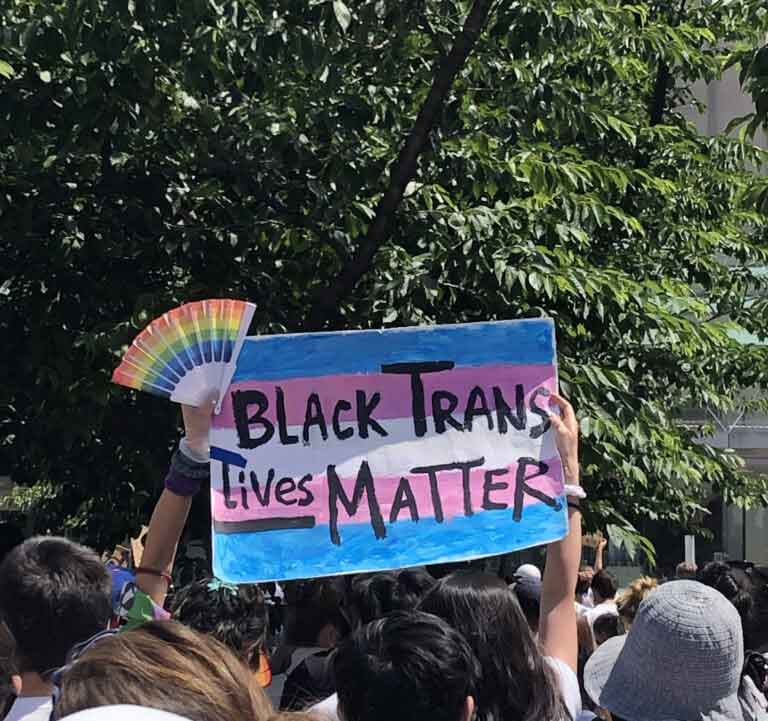
Black Trans Lives MatterUnfortunately, fatal violence and legal discrimination against TGNC people are also at an all-time high as increased visibility and progress is often followed by a conservative backlash, particularly against those most vulnerable in the community. And of course this leads to heartbreaking health impacts. According to The Trevor Project, more than half of transgender and nonbinary youth have seriously considered suicide.
As voice actors and humans of all walks of life, Blue Wavers understand how critical – how life-saving – it is to not only celebrate diversity, but actively build inclusive and safe spaces everywhere for marginalized people. So here are a few tips from us on how to create safer spaces for transgender and gender non-conforming voiceover artists and all TGNC people.

And if you want to check out our talented TGNC voice talents, search artist bios here.

1. Learn & Use Inclusive Language

Blue Wave Voiceover Cherie
Cherie B. Tay

LGBTQ+ History and Identity 101 are being taught more and more in schools. Young people are learning that there are more than two genders and that in fact, there’s a whole beautiful spectrum of gender identities that have existed across the globe for thousands of years. But not all of us have encountered such an inclusive education. Sometimes, it may even feel a little embarrassing to not understand certain terms or facts that we’ve never heard about something so personal as gender. But it’s never too late to learn! And this learning is urgently critical to creating safer spaces for not only TGNC voice actors, but all TGNC people.

To get started, here are some helpful definitions from the Human Rights Commission’s Glossary of Terms:

Gender identity: One’s innermost concept of self as male, female, a blend of both or neither – how individuals perceive themselves and what they call themselves. One’s gender identity can be the same or different from their sex assigned at birth.

Transgender: An umbrella term for people whose gender identity and/or expression is different from cultural expectations based on the sex they were assigned at birth. Being transgender does not imply any specific sexual orientation. Therefore, transgender people may identify as straight, gay, lesbian, bisexual, etc.

Gender Non-Conforming: A broad term referring to people who do not behave in a way that conforms to the traditional expectations of their gender, or whose gender expression does not fit neatly into a category. While many also identify as transgender, not all gender non-conforming people do.

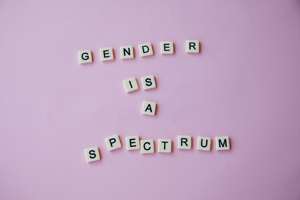
Blue Wave Voiceover Gender Is A Spectrum

Non-Binary: An adjective describing a person who does not identify exclusively as a man or a woman. Non-binary people may identify as being both a man and a woman, somewhere in between, or as falling completely outside these categories. While many also identify as transgender, not all non-binary people do. Non-binary can also be used as an umbrella term encompassing identities such as agender, bigender, genderqueer or gender-fluid.

Cisgender: A term used to describe a person whose gender identity aligns with those typically associated with the sex assigned to them at birth.

Even changing small but powerful phrases like saying “all genders” instead of “both genders” is important and makes a difference!.

Check out The Trevor Project’s Support Center for more LGBTQ+ 101 learning.

2. Share & Ask Pronouns

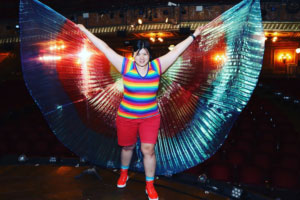
Pronouns are how you like others to refer to you when not using your name. Cherie-prideJust like gender identity, there are more than the two sets of pronouns that often come to mind: she/her/hers and he/him/his. People also use they/them/theirs and the singular “they” has been common in English for decades. Other sets of pronouns include e/em/eirs, ze/hir/hirs, ve/ver/vers, and more! Some people use multiple pronouns like they/she or they/he.
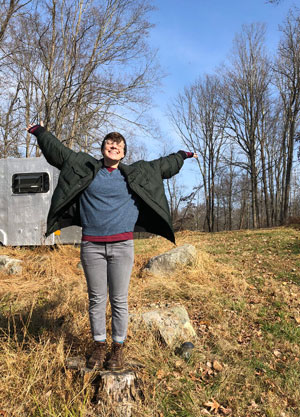
So how do you know someone’s pronouns? Ask! Nowadays, it’s common-practice – and totally okay! – to ask someone their pronouns. As in, “Hey my pronouns are they/she, what are yours?” or “I didn’t catch your pronouns before! I’m Marianna, she/her.” It may feel a little awkward at first but what’s more awkward – and harmful – is misgendering someone by assuming their pronouns. And according to The Trevor Project, “Transgender and nonbinary youth who reported having pronouns respected by all or most people in their lives attempted suicide at half the rate of those who did not have their pronouns respected.”

Meeting someone over email? Include your pronouns in your email signature and mention them when you e-intro yourself like “Hi Jamal, so happy to connect! I’m Em (they/them)!”

Allegra
Allegra Verlezza

Does a person’s pronouns tell you their gender identity? Nope! Pronouns don’t equal gender identity. Folks who use the same pronouns might all identify differently in terms of gender. Folks who all share the same gender identity may all use different pronouns. And remember, no person “is a they.” They use them/them/their pronouns.

Golden rule: don’t assume. Everyone’s their own unique person so get to know them by sharing pronouns!

Check out GLSEN’s Pronoun Guide to learn more.

3. Stay Teachable

Cherie-prideAll of this can often come with the big bad fear of messing up. But guess what? We all mess up! And we’re all going to mess up because we’re human. What’s important is staying teachable and accountable.

Accidentally used the wrong pronoun for someone? Apologize to them, correct yourself with the right pronoun, and move on. Then on your own time, practice!

Having a hard time learning new pronouns? Practice with a friend! Practice saying things out loud that you would actually say like “wow, they have the coolest voice!” or “yeah I hung out with them the other day and they brought their adorable dog!”

Filed Under: Representation, Blog, Meet The Talent

Queer, Genderfluid & Non-Binary Voiceover – Meet Allegra Verlezza
April 17, 2021 by Blue Wave Voiceover

Allegra Verlezza – Queer, Genderfluid & Non-Binary Voiceover

Link to full profile: bluewavevoiceover.com/voices/allegra-verlezza

Email: allegra@allegraverlezza.com

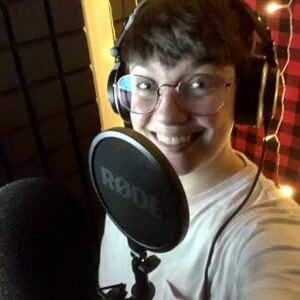
If you’re looking for a queer, non-binary and genderfluid voiceover talent who can deliver your political spot with authenticity and passion, meet Allegra Verlezza! Allegra (they/she) is a proud member of the LGBTQIA+ community and as a genderfluid person, feels comfortable and affirmed voicing roles for women and non-binary folks. They are committed to amplifying progressive messages that advance real, meaningful change.

Tell us a little about your broadcast-quality home studio. Where is it? What kind of equipment do you have? What do you like about it?

My home studio is a creative hybrid of a closet booth and a free-standing blanket booth in my Brooklyn apartment. My closet and its doors are completely lined with 2 inch thick foam panels and I situate myself and my mic between the open closet doors. I have Producer’s Choice sound-absorbing blankets running along a ceiling track outside of the closet that act as curtains and quietly enclose my booth. As for light, I have a dreamy curtain of twinkle lights behind me which makes it feel like the coolest blanket fort ever.

In terms of equipment, I have a Rode NT1 mic, Solid State Logic SSL2 audio interface, and a computer monitor hooked up to my Macbook Air that sits right outside of my booth. I found these nifty mobile, adjustable desks that are meant for close-quarters living in a college dorm (not unlike living in NYC) and I converted two of them into mobile booth desks. All of my tech, including my iPad for reading scripts, either sits on these desks or are clamped to the sides so none of my equipment has to be fixed to one spot. Most of the time I stand so I can access my full range of wacky and dramatic movement but if I have a longer session, I can easily pop a stool into the booth since all my equipment is mobile.

I love this accessible and malleable quality about my booth because it means I always have the room to move and be physically present as an actor. What I don’t like about it? Well, it’s situated next to a window that looks out over a loooong row of backyards so I could do without the trees knocking against my building, music blasting, or the flocks of birds that seem to run formation drills every afternoon.

Update: my cat has discovered that he can claw open my blanket curtains and zoom around me. Send help.

What’s one thing that most people don’t know about you?

My first foray into performance was through dance! I grew up in a family of modern dancers, who specialized in making dance accessible to people of abilities and minds. I spent many years studying modern dance and ballet and I still love to dance – especially at queer dance parties! This early exposure to diverse types of movement and just being comfortable with wiggling my limbs really instilled in me a deep presence and comfort with moving my body. I totally bring this connection to dance and my body into my booth because as we know, EVERYTHING influences the voice and vocal performance and that definitely includes moving and feeling alive and activated in my body.

How did you get into voiceover work?

Buckle in. From being a cartoon-obsessed kid to a high school theater dork to an adult actor who convinces all their friends to watch the latest animated shows – especially the growing number of cartoons with LGBTQ+ rep – I LOVE vocal performance! I always have. It’s just…its own kind of magic when an actor breathes life into a bunch of moving lines and color. I wasn’t always able to name and celebrate this passion though. The person who gave me the confidence to own my continued love of cartoons as an adult is Rebecca Sugar, cartoonist/artist/showrunner extraordinaire and creator of Steven Universe. And a fellow bisexual and non-binary creative! Watching the literal slew of diverse LGBTQ+ characters in her show, I saw myself for the first time in a cartoon. Listening to interviews where Sugar speaks so unapologetically about her lifelong love of animation was a really healing experience for me as a young person who (is this not ridiculous?) was put down a lot for loving these animated shows that quite literally saved my life. I even got into cosplay!

SO. This beautiful moment of self-actualization along with still loving acting and being miserable at my first job out of college made me think, “well, why can’t I try voice acting and being in cartoons?” I started researching classes and then the real catalyst was a colleague of mine who saw me LIGHT UP with curiosity and joy when she mentioned that her sister worked full-time in animation. That colleague connected me to her sister who connected me to someone else in the industry (are you following?), who generously took the time to have coffee with me and answer alllll my questions about getting into voice acting and children’s media. I walked out of that midtown coffee shop, whipped out my phone, and signed up for my first voiceover class.
And you know what I found? There are SO MANY awesome types of voiceover! I hopped from class to class, discovering different genres – like political! – and jumped head-first into the incredible world of voiceover. The short answer – I took a class. The longish answer – a bunch of people paid it forward by being their full authentic selves and generously fostering other people’s joy.

What is your biggest voiceover pet peeve?

My biggest pet peeve in voiceover is when listeners assume a voice of a certain identity sounds a certain way. As a queer genderfluid person, this becomes personal when it comes to voice actors under the non-binary umbrella. The voiceover industry has made a lot of progress in terms of diverse casting but unfortunately, there are still a lot of expectations that a “non-binary voice” is a monolith and should “sound androgynous” or “neutral” or… non-gendered? My voice is full of gender! A big, colorful, messy painting of gender. And I “sound non-binary” because I am non-binary. Even though my voice isn’t mid-low range or what people often deem “androgynous-sounding,” I sound genderfluid because I am genderfluid. And there are non-binary voices that do have those qualities and that’s fantastic! It just shouldn’t be an assumed standard that is frankly grounded in patriarchal, cis-centric views of gender.

This automatic coupling of certain vocal qualities with certain gender identities (i.e. women’s voices sound like X and men’s voices sound like Y) fails to realize a beautiful truth: just as sexuality and gender identity are diverse spectrums, so is voice. And just like we’re unlearning so many things ingrained in us from the oppressive structures in our society, we’re unlearning assumptions and taught biases about what a certain identity’s voice sounds like. I encourage folks, in all fields but especially in voiceover, to not limit ourselves with rigid ideas about what a certain gender identity sounds like. What any identity sounds like, including women and men! Let’s embrace the fact that anyone can quite literally sound like anything. After all, my biggest voiceover LOVE is that this community is so supportive and this craft is all about being fully and authentically YOU.

What advice do you have for talents who want to do political voiceover?

Well, to follow up on the above, BE YOU. Be fully, freely, totally you. This advice goes for all genres of voiceover but especially when it comes to political work. (My gender studies degree is screaming everything is political! But let’s talk genre.) Go inward. Who are you and what are your fights? Go outward towards community. Who are you in solidarity with and who are you fighting for? Bring all of this specificity to your reads, even if it’s not you explicitly giving literal words to this. Bring the feeling, the passion, the urgency, the compassion, the humanity.

What hobbies do you have outside of your voiceover work?

Fiber arts! I’ve loved knitting ever since I begged my mom at the age of 8 to buy me a pair of needles and the COOLEST rainbow tie-dye yarn I found at Michaels (#CanonicallyQueer). I knitted throughout childhood – my mom still uses this lumpy eyeglasses holder I made for her, bless her heart – and after a several-year pause, I picked up a pair of needles again when I was feeling quite low in my early twenties. And my goodness does knitting do wonders for anxiety and depression! I love to be able to create something out of nothing with my hands. It occupies my busy mind and is a perfect way to relax my voice after a long day of auditions.

If you’d like to meet Allegra Verlezza for your next political voiceover project, please visit their profile here and get in touch!

Filed Under: Representation, Meet The Talent

Hispanic Female Voiceovers in English and Spanish – Meet Rosi Amador

September 5, 2020 by Blue Wave Voiceover

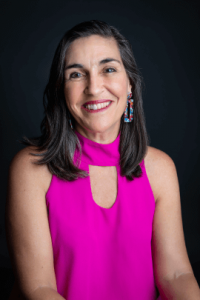
Blue Wave Voiceover Rosi Amador photoRosi Amador – Hispanic Female Voiceovers in English and Spanish

Link to full profile: bluewavevoiceover.com/voices/rosi-amador/

Email: rosi@amadorbilingualvoiceovers.com

When you’re looking for a female voiceover talent who can deliver your political spot flawlessly in both English and Spanish, look no further than Hispanic bilingual voiceover talent, Rosi Amador. Rosi actually comes from a family of bilingual voiceover artists. We’re proud to have her husband Brian on our Blue Wave Voiceover roster as well. Rosi is also able to deliver copy in English with an authentic Hispanic accent. We know that the Latin and Hispanic community represents a large part of the electorate and is a huge target for Democratic candidates and ballot initiatives, so using a confident female voice like Rosi can authentically help get your message into the right ears!

Tell us a little about your broadcast-quality home studio. Where is it? What kind of equipment do you have? What do you like about it?

We’re lucky to live in a lovely, solidly built 1850’s home in a quiet neighborhood in Cambridge MA where we set up a professional home studio to record our music in the 1990’s. In 2009 we vamped it up for voiceovers. We’re 100% Remote-Ready with SourceConnect Pro, ipDTL, phone patch or Zoom/Skype available for our clients to listen in or direct in real time.  We use various topnotch microphones including a Warm Audio WA-87, CAD E100S, Audio Technica AT4040, AKG Perception 220, Shure SM-7B and AKG Perception 120, an Apogee Duet 2 preamp/interface. Our preferred DAW is Twisted Wave but we also use Digital Performer 9, Logic Pro and Reaper recording software.

What’s one thing that most people don’t know about you?

Many of our voiceover clients may not know that we’re also professional Latin musicians. In fact we toured for 27 years prior to choosing to move into our full-time voiceover career in 2009. I am our Latin band Sol y Canto‘s lead singer and bongo player/percussionist and my husband Brian is our composer/arranger and a fabulous Spanish guitarist if I do say so myself. I am passionate about doing improvisational singing these days and am furiously studying it online during this pandemic so that I can come out scatting like Ella Fitzgerald (I wish).

How did you get into voiceover work?

A music colleague and fan asked us to record children’s stories and eLearning modules for Scholastic in the early 90’s and we thoroughly enjoyed it. A few years later the hospital where I gave birth to our twins caught wind that I was a Latin singer with a following and asked me to record a testimonial in both English and Spanish as a TV and radio spot. I went into my first pro voiceover studio downtown in Boston and recorded with several producers listening in and directing. It went great and I was hooked. Right then and there I decided I would pursue bilingual voiceovers as a way of using my voice creatively moving forward that didn’t require that I tour constantly away from my infant twins once they started school. I recorded part-time as I built up my client base and went full-time in 2009. I love it!

Do you remember the first voiceover job you ever did?

The first spot was for the Hospital I gave birth in – St. Elizabeth’s Hospital in Boston. It was a bilingual spot about what good care they took of me and my premature twins. All true and very personal. I did it pro-bono to help the hospital and their wonderful NICU nurses and doctors.

What has been your favorite voiceover project – political or otherwise – to date?

I had the privilege of being selected to record the overdubbed English voice for the fearless indigenous leader Nemonte Nenquimo in “Global Goal: Unite for our Future,” an internationally broadcast documentary and concert. It calls on citizens to tackle global injustices by using our collective voice to drive change for everyone, everywhere. This online event was produced by Global Citizen, a social action platform for a global generation that aims to solve the world’s biggest challenges and promotes social change. Here it is:

Why do you think voiceover is an important part of political advertising this season?

Now more than ever diverse voices must be uplifted, and all the Democratic and progressive candidates know that they must include Latin, Hispanic, African-American and our Native populations voices in their campaigns in order to be voted in. These populations are amongst the ones that have been most hard hit by the double crisis of the pandemic and systemic racism.

What issues would you like to see at the center of the Democratic platform for this year’s election?

Ending the separation of immigrant children from their families; radical immigration reform, including protection for Dreamers,
policies to combat systemic racism including community-based police department reform, access to quality early childhood education, and quality healthcare coverage for all.

What is your biggest voiceover pet peeve?

When clients send me scripts in Spanish that were translated by Google Translate or by someone who is not a professional translator and they are literally translated in a way that no Latin or Hispanic person would ever speak. It happens more often that I care to say, and puts me in the uncomfortable position of having to point this out to the client and help them fix these problems. I will not voice anything that is not written in proper Spanish, so I’m happy to help with this, but it’s not how I prefer to use my time. I do my best to educate each client so that when they return they’ll have a pro to send the script to in advance. It’s a win/win.

Sol Y CantoIf you could tell political voiceover clients one thing that would help you do your job better, or help them get what they want faster – what would that one thing be?

I frequently record bilingual versions of spots and very often the Spanish is too long for the :30 or :60 time frame. There are 25-30% more words in Spanish than in English, so if the creative team hires a pro translator who understands and practices the script to see if it’ll fit into the amount of time that’s available, by the time the script gets to me it’s good to go. It is usually well written and I don’t have to rush (making it sound like a used car sales ad!) This makes my job way easier and more fun! I love doing political spots for causes and folks I believe in when I get the opportunity.

What advice do you have for talents who want to do political voiceover?

Study with knowledgeable voice acting coaches or an acting coach, listen to political ads and learn about the different styles so you’re fluent in them and will know what approach to take when you get a script.

What hobbies do you have outside of your voiceover work?

I’m a longtime yoga practitioner and I meditate daily. My husband and I also do a vocal improvisation every morning after we meditate together. It’s a great way to start off the day before I exercise. And I LOVE to travel, when it’s allowed! Can’t wait.

Any final thoughts?

It’s an honor for me to be able to represent the Latin community in my political voiceover work. I am frequently hired to be the voice of an immigrant, a business owner, or to voice the spot of a Latin political candidate who is trying to make things better for my community. There is no higher honor than this one, whether it’s in English, Spanish or Hispanic-accented English.

If you’d like to book Rosi Amador on your next political voiceover project, please visit her profile here and get in touch!

Filed Under: Representation, Meet The Talent

  • Page 1
  • Page 2
  • Page 3
  • Go to Next Page »

Primary Sidebar

Categories

Recent Posts

  • Affordability: How Political Voice Over Shapes Voter Opinions in the Midterms
  • Why the 2026 Midterms Need Female Political Voice Over
  • Asian American and Pacific Islander Voiceover
  • Political Advertising Trends 2026: How Authentic Voices Are Reshaping Campaigns
  • Hire Award-Winning Political Voice Over Talent

Contact Us

Feel free to cast directly from our roster by e-mailing any of our professional political voiceover actors. If you're unsure which voice is right for you; we'd be happy to provide free, no-obligation auditions from our roster. Simply e-mail your script and specs to casting@bluewavevoiceover.com with your timeline, and we'll get your MP3 auditions back to you immediately. Or, fill out the form below, and a team member will get back to you the same day.

This field is for validation purposes and should be left unchanged.
Max. file size: 1 GB.

Privacy Policy | Terms and Conditions
©2026 Blue Wave Voiceover // Voice Over Site by Voice Actor Websites